If you own or rent out a commercial property in the UK, you've probably heard the term "commercial EPC" thrown around. Maybe your solicitor mentioned it. Maybe a letting agent brought it up. Or maybe you just stumbled across it while trying to figure out what paperwork you need before marketing a building.
Either way, there's a good chance nobody has explained it to you properly, just handed you a form, told you it's a legal requirement, and left you to figure out the rest.
So let's fix that.
This post covers what a Commercial Energy Performance Certificate actually is, how it works in practice, what the ratings mean for your property, and perhaps most importantly why the next few years are going to matter a lot more than most landlords currently realise.
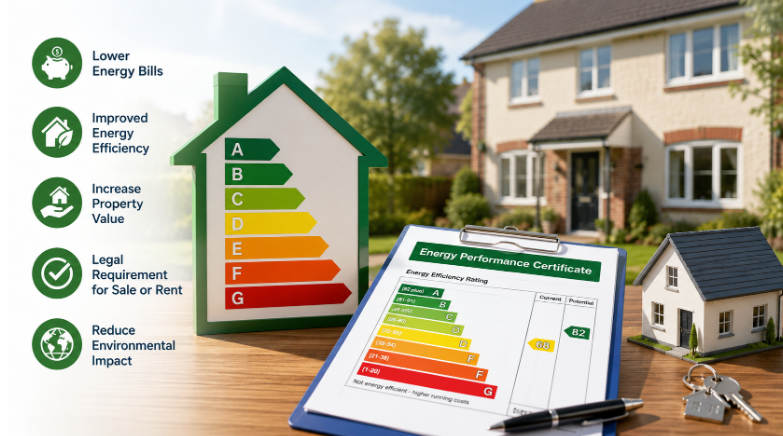
Commercial Energy Performance Certificate
First Things First: What Is a Commercial EPC?
A Commercial Energy Performance Certificate is an official document that tells you how energy efficient a non-domestic building is. It gives the property an energy rating between A and G A being the most efficient, G being the least based on an on-site assessment carried out by an accredited assessor.
The key word there is non-domestic. Commercial EPCs cover everything that isn't a home: offices, warehouses, retail units, restaurants, medical clinics, industrial buildings, and so on.
Think of it a bit like the coloured energy label you see on a washing machine or a fridge. It doesn't tell you how the current occupier uses the building, it tells you how efficient the building itself is, based on its construction, heating systems, lighting, and so on. That's what's called an asset rating, and it's what commercial EPCs are based on.
Who Actually Needs One?
You need a Commercial EPC in three main situations:
When you're selling a commercial property. The EPC needs to be made available to prospective buyers. There's no getting around this; it's a legal requirement under the Energy Performance of Buildings Regulations 2012.
When you're letting (or re-letting) a commercial property. Before you market the building to a new tenant, you need a valid certificate in place. This applies every time a new tenancy begins.
When a new commercial building is completed. Any newly constructed non-domestic building requires an EPC as part of the handover process.
There are some exemptions listed buildings in some cases, temporary structures, buildings under 50m², certain industrial sites with very low energy demand but they're narrow and often misunderstood. If you're not sure whether your property qualifies for an exemption, it's worth getting proper advice rather than assuming.
What Do the Ratings Actually Mean?
The A–G scale sounds simple, but it's worth understanding what it means in practice, especially because the consequences of different ratings are changing rapidly.
A and B are the top of the range. Most buildings here are either newly built to modern standards or have had significant energy improvements carried out. Highly insulated, efficient heating systems, modern controls.
C and D represent the middle ground. A lot of decent commercial stock sits here in older buildings that aren't cutting-edge but aren't energy disasters either.
E is where things start to get legally significant. Under current rules, E is the minimum rating a landlord can have and still legally let a commercial property. Anything below E an F or G rating means you technically cannot let the building unless you have a registered exemption.
F and G represent the tail end of the efficiency spectrum. If your building is here, you've got a problem that needs addressing, and soon.
The rating isn't a judgement on how you run your business, it's about the building itself. A well-run company in an inefficient building will still get a poor EPC rating.
Here's What Most Landlords Don't Realise About the Next Few Years
This is probably the most important part of this post, and it's where a lot of commercial landlords are genuinely underprepared.
The government's Minimum Energy Efficiency Standards MEES, for short, are getting significantly tighter for commercial properties in England and Wales. Here's how the timeline looks:
Right now: You cannot let a commercial property with an EPC rating of F or G. This has been the rule since April 2023 and it applies to ongoing tenancies, not just new ones.
2027: The government's proposal is that all rented commercial properties will need to achieve at least an EPC C rating. That's not a target for new leases only it's intended to apply to existing tenancies too.
2030: A further tightening to EPC B is proposed, making the minimum standard even higher.
These dates feel distant until they don't. Landlords who are currently sitting on a D or E rating might feel comfortable today, but 2027 is less than two years away. Energy improvement works insulation, heating upgrades, lighting replacements take time to plan, procure, and install. And if your building requires planning permission or listed building consent for any changes, the timeline gets longer still.
The other thing worth knowing: these upgrades cost money. Many landlords who get ahead of the curve now are doing so partly because they can plan costs on their own terms, rather than being forced into rushed expenditure under time pressure or tenant pressure.
How Does the Assessment Actually Work?
If you've never had a commercial EPC done before, you might be picturing something like a quick walk-around with a clipboard. The reality is a bit more involved and the quality of the assessment matters more than most people realise.
An accredited Non-Domestic Energy Assessor visits the property and collects detailed information about the building. That includes the construction of how the walls, roof, and floors are built, what glazing is in place as well as the heating and hot water systems, ventilation and cooling, and lighting.
The inspection time can range from an hour for a small, straightforward unit to a full day for a larger or more complex building. After the visit, the data is fed into specialist software that calculates the rating.
Here's the bit that actually matters for your rating: a good assessor uses actual efficiency data from your installed systems, the real performance figures for your boiler, your heat pump, your HVAC. A less diligent assessor, or one who hasn't gathered enough detail on-site, will fall back on software default values. Those defaults are conservative assumptions, and they almost always produce a worse rating than the building would get with accurate data.
That's not a minor technicality. The difference between actual data and a software default can be enough to shift a property from a D to a C, or from an E to a D. Given where the MEES regulations are heading, that gap could mean the difference between a compliant property and a non-compliant one.
Once the assessment is done and the certificate is lodged on the national register, you'll receive the certificate itself, the government register link, and a recommendations report a document that outlines practical steps you could take to improve the rating.
How Long Does a Commercial EPC Last?
A Commercial EPC is valid for 10 years. That said, if you carry out significant works to the building replacing the heating system, adding a major extension, substantially improving insulation it's worth commissioning a new assessment. You may have improved the rating, which matters a great deal if you're approaching a tenancy renewal or a sale.
What Does It Cost?
Commercial EPC costs vary quite a bit, and it's worth understanding why rather than just shopping for the cheapest quote.
Smaller, simpler units, a single-storey retail shop, and a small office tend to sit at the lower end of the cost range, often starting from a few hundred pounds. Larger or more complex buildings will cost more, because they take longer to assess properly.
The factors that typically influence cost are building size, the number and complexity of HVAC systems, the location (assessors factor in travel), and how urgently you need the appointment.
The thing to keep in mind: the cost of an EPC is almost always trivial compared to the cost of a penalty for non-compliance, or the cost of a property sitting empty because it can't legally be let. Getting it done properly by an accredited assessor using real data is where the value actually lies.
Commercial EPCs and Display Energy Certificates: Not the Same Thing
These two certificates get confused fairly regularly, so it's worth being clear on the difference.
A Commercial EPC which is what this post is mostly about rates a building's theoretical energy efficiency. It's based on the building's construction and fixed systems, not how it's actually being used.
A Display Energy Certificate, or DEC, is different. It applies specifically to public buildings, schools, hospitals, libraries, council offices and rates a building's actual energy use over the past 12 months. DECs have to be prominently displayed in the building, and they're renewed more frequently than commercial EPCs.
If you manage a public authority building, you'll need a DEC rather than (or sometimes in addition to) a standard commercial EPC.
What Happens If You Ignore It?
Fines for non-compliance with EPC requirements can reach £5,000 for failing to produce a certificate when required in a transaction. Under MEES, penalties for letting a non-compliant property can reach up to £150,000 depending on the rateable value of the building.
Beyond the financial penalties, non-compliance is visible. The EPC register is publicly searchable. Tenants, buyers, and their solicitors will check it. A missing or non-compliant certificate slows down transactions and raises red flags.
A Few Practical Tips Before You Book an Assessment
If you're getting ready to have a commercial EPC done, there are a few things that can help the process go smoothly and potentially improve your outcome:
Gather what you can about your heating and hot water systems. Manufacturers' data sheets, installation records, service logs, anything that gives accurate efficiency figures for your installed equipment. A good assessor will ask for this. If you can provide it, they can use real data rather than defaults.
Don't ignore the recommendations report. A lot of people file it away and never look at it again. It's actually one of the most useful documents. The process produces a road map of what you could do, in rough order of impact, to improve your building's energy performance. With 2027 approaching, it deserves more than a drawer.
If your building is sitting at E or just inside it, talk to your assessor before the certificate is lodged. There may be quick improvements worth making first, or data worth checking again, that could make a difference to the final rating.
Commercial Energy Performance Certificates aren't going away, and the standards attached to them are getting stricter. For most commercial landlords in England and Wales, the question isn't really whether to engage with this, it's how soon and how seriously.
Getting an accurate, properly evidenced assessment is the starting point. Understanding what your rating means for your compliance position today and in two to three years is the next step. And for properties sitting in the middle of the efficiency scale, having a plan for improvement before the deadlines arrive is genuinely worthwhile.
If you own or manage commercial property in Kent, Essex, London, or Surrey and need a commercial EPC or just want to understand where your buildings currently stand, EEA Action Ltd carries out accredited assessments using actual efficiency data, with short-notice slots available.
Frequently Asked Questions (FAQ’s)
My tenant has been in the building for years. Do I still need a commercial EPC?
This catches a lot of landlords off guard. The MEES regulations don't just apply when you sign a new lease since April 2023, they apply to continuing tenancies too. So if your building is rated F or G and a long-standing tenant is still in occupation, you're technically in breach unless you have a registered exemption in place. It's not just a "new lettings" rule anymore, which is exactly why a lot of landlords with older stock need to act now rather than waiting until the next lease event.
Can I sell a commercial property if it has a low EPC rating?
Yes, you can. The EPC minimum standards under MEES apply specifically to letting, not to sales. There's no legal minimum rating required to sell a commercial property. That said, you do still need a valid EPC to be available during the sales process, and the rating will be visible to buyers and their solicitors. A poor rating particularly an F or G will almost certainly affect the sale price and may put off buyers who don't want to take on an asset they can't legally let without improvement works.
What counts as a valid exemption if my building is below the minimum rating?
There are a handful of registered exemptions available to landlords who genuinely cannot meet the minimum EPC standard. The most common ones cover situations where: all reasonable energy improvement measures have already been made and the property still can't reach the required band; a third party such as a tenant or a planning authority has refused consent for the necessary works; or improvement works would devalue the property by more than five percent. Crucially, exemptions have to be registered on the PRS Exemptions Register; you can't just decide internally that you qualify. They're also time-limited, typically lasting five years, and they don't transfer to a new owner if the property is sold.
Does the EPC rating affect how much I can charge in rent?
Not directly there's no legal mechanism that ties rental value to EPC band. But indirectly, yes, it matters. Tenants are becoming more aware of energy costs, particularly since energy prices spiked in recent years. A building with a poor EPC rating typically costs more to heat and run, which makes it less attractive and gives tenants more negotiating leverage on rent. On the other side of that, a well-rated building is increasingly seen as a positive asset, particularly for businesses with their own sustainability commitments or ESG reporting obligations.
If I improve my building, do I need to get a new EPC straight away?
There's no automatic legal trigger that forces you to get a new EPC the moment you carry out improvement works as long as your existing certificate is still within its 10-year validity period. But here's the practical reason to consider getting one anyway: if the improvements are significant enough to shift your rating into a higher band, having that reflected on the register matters. It protects your compliance position, makes the property easier to let or sell, and if you're heading toward the 2027 or 2030 deadlines gives you documented evidence that you've acted. A new EPC after major works is often money well spent.